×
Request Free Sample ×

Kindly complete the form below to receive a free sample of this Report

Leading companies partner with us for data-driven Insights

clients tt-cursor
Hero Background

India Incident Emergency Management Market

ID: MRFR/ICT/58749-HCR
200 Pages
Aarti Dhapte
October 2025

India Incident Emergency Management Market Research Report By Solution (Geospatial Technology Solution, CBRNE/Hazmat Solution, Situational Awareness Solution), By System (Simulation Systems) and By Professional Service (Training, Consultant)-Forecast to 2035

Share:
Download PDF ×

We do not share your information with anyone. However, we may send you emails based on your report interest from time to time. You may contact us at any time to opt-out.

India Incident Emergency Management Market Infographic
Purchase Options

India Incident Emergency Management Market Summary

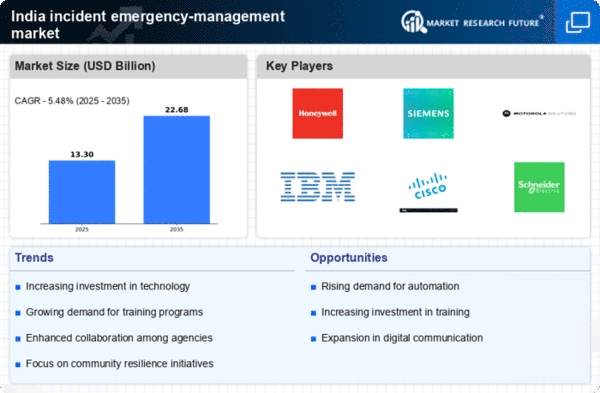
As per MRFR analysis, the incident emergency-management market size was estimated at 12.61 USD Billion in 2024. The incident emergency-management market is projected to grow from 13.3 USD Billion in 2025 to 22.68 USD Billion by 2035, exhibiting a compound annual growth rate (CAGR) of 5.48% during the forecast period 2025 - 2035.

Key Market Trends & Highlights

The India incident emergency-management market is experiencing robust growth driven by technological advancements and increasing urbanization challenges.

  • Technological integration is reshaping incident management strategies across various sectors.
  • Capacity building initiatives are gaining traction, enhancing the skills of emergency responders.
  • Collaborative frameworks among government and private entities are becoming essential for effective incident management.
  • Rising urbanization challenges and increased awareness and preparedness are key drivers propelling market growth.

Market Size & Forecast

2024 Market Size 12.61 (USD Billion)
2035 Market Size 22.68 (USD Billion)
CAGR (2025 - 2035) 5.48%

Major Players

Honeywell (US), Siemens (DE), Motorola Solutions (US), IBM (US), Cisco Systems (US), Schneider Electric (FR), Raytheon Technologies (US), Northrop Grumman (US), General Dynamics (US)

India Incident Emergency Management Market Trends

The incident emergency-management market is currently experiencing a transformative phase. This transformation is driven by the increasing frequency of natural disasters and the growing need for effective response strategies. In recent years, the Indian government has prioritized enhancing its emergency response capabilities, leading to the establishment of various frameworks and initiatives aimed at improving disaster preparedness. This shift reflects a broader recognition of the importance of resilience in the face of potential crises. Furthermore, advancements in technology are playing a crucial role in shaping the market landscape. The integration of innovative solutions, such as real-time data analytics and communication systems, enhances the efficiency of emergency management operations. As a result, stakeholders are increasingly investing in these technologies to bolster their response capabilities. In addition to technological advancements, there is a notable emphasis on training and capacity building within the incident emergency-management market. Government agencies and organizations are focusing on developing skilled personnel who can effectively manage emergencies. This trend is indicative of a proactive approach to disaster management, where preparedness is prioritized over reactive measures. Moreover, collaboration among various stakeholders, including government bodies, NGOs, and private sector entities, is becoming more prevalent. Such partnerships are essential for creating a comprehensive and coordinated response framework, ultimately leading to improved outcomes during emergencies. Overall, The incident emergency-management market is evolving rapidly. It has a clear focus on innovation, training, and collaboration to address the challenges posed by emergencies.

Technological Integration

The incident emergency-management market is witnessing a surge in the adoption of advanced technologies. Tools such as drones, artificial intelligence, and mobile applications are being utilized to enhance situational awareness and streamline communication during emergencies. This trend indicates a shift towards more efficient and effective response mechanisms.

Capacity Building Initiatives

There is a growing emphasis on training programs aimed at enhancing the skills of personnel involved in emergency management. Government and non-government organizations are investing in capacity building to ensure that responders are well-equipped to handle various crisis situations. This focus on education reflects a commitment to improving overall preparedness.

Collaborative Frameworks

The incident emergency-management market is increasingly characterized by partnerships among diverse stakeholders. Collaboration between government agencies, NGOs, and private sector organizations is becoming essential for developing comprehensive emergency response strategies. This trend suggests a move towards a more integrated approach to managing incidents.

India Incident Emergency Management Market Drivers

Rising Urbanization Challenges

Rapid urbanization in India is leading to increased population density in cities. This poses significant challenges for the incident emergency-management market. As urban areas expand, the risk of incidents such as fires, floods, and accidents rises. According to government data, urban areas are expected to house over 600 million people by 2031, necessitating robust emergency management systems. This growth drives demand for advanced technologies and strategies to manage incidents effectively. The incident emergency-management market must adapt to these challenges. This adaptation requires implementing innovative solutions that address the complexities of urban environments. Enhanced infrastructure, real-time data analytics, and community engagement are essential components that can improve response times and overall effectiveness in managing emergencies in densely populated areas.

Government Policy and Regulation

The Indian government is increasingly focused on enhancing disaster management policies and regulations. This focus significantly impacts the incident emergency-management market. The Disaster Management Act of 2005 laid the foundation for a structured approach to managing emergencies. Recent amendments and initiatives aim to strengthen the framework for disaster preparedness and response. The government allocates substantial funding, with the National Disaster Response Fund (NDRF) receiving over $1 billion annually to support various emergency management initiatives. This financial backing encourages the development of advanced technologies and training programs, thereby fostering growth in the incident emergency-management market. As policies evolve, stakeholders must align their strategies with government objectives to ensure compliance and effectiveness in managing incidents.

Increased Awareness and Preparedness

There is a growing awareness among the Indian populace regarding the importance of preparedness for emergencies, which positively influences the incident emergency-management market. Public campaigns and educational programs have been initiated to inform citizens about disaster risks and response strategies. According to surveys, approximately 70% of urban residents now recognize the need for personal and community preparedness plans. This heightened awareness drives demand for training programs, emergency kits, and community drills, thereby expanding the market. Organizations are increasingly investing in awareness campaigns and preparedness training, which not only enhances community resilience but also stimulates growth in the incident emergency-management market. As individuals become more proactive, the overall effectiveness of emergency response systems is likely to improve.

Climate Change and Environmental Factors

The impact of climate change is increasingly evident in India. It leads to more frequent and severe weather-related incidents. This trend significantly influences the incident emergency-management market, as the need for effective response strategies becomes more pressing. The Indian Meteorological Department has reported a rise in extreme weather events, including floods and cyclones, which necessitates enhanced preparedness and response mechanisms. The government has recognized this challenge, allocating over $2 billion for climate resilience initiatives. This funding supports the development of infrastructure and technologies aimed at mitigating the effects of climate change on communities. As environmental factors continue to evolve, the incident emergency-management market must adapt to address these challenges, ensuring that systems are in place to respond effectively to climate-induced incidents.

Technological Advancements in Communication

Advancements in communication technologies are transforming the incident emergency-management market in India. The proliferation of mobile devices and internet connectivity has enabled real-time communication during emergencies, facilitating quicker response times. Technologies such as Geographic Information Systems (GIS) and mobile applications are being integrated into emergency management strategies, allowing for better resource allocation and situational awareness. Government initiatives have promoted the use of technology in disaster management, with investments exceeding $500 million in recent years. These advancements not only enhance the efficiency of emergency responses but also improve coordination among various agencies involved in incident management. As technology continues to evolve, the incident emergency-management market is likely to see further innovations that enhance operational capabilities.


Market Segment Insights

By Solution: Geospatial Technology Solutions (Largest) vs. Situational Awareness Solutions (Fastest-Growing)

In the India incident emergency-management market, the distribution of market share among the solution segment values reveals a strong preference for Geospatial Technology Solutions, which dominate the landscape due to their advanced capabilities in mapping and analysis. Similarly, CBRNE/Hazmat Solutions play a critical role in ensuring safety and compliance, but they hold a smaller share compared to Geospatial Solutions. In contrast, Situational Awareness Solutions, while not as established, are rapidly gaining traction, showing significant promise for the future. Growth trends in this market segment are driven by increasing investments in technology and infrastructure aimed at enhancing public safety and disaster response. The rise in natural disasters and the need for quick, accurate information during emergencies have propelled the demand for innovative solutions. Moreover, government initiatives and collaborations with private sector players are further amplifying the growth and expansion potential of Situational Awareness Solutions, positioning them as a crucial element in emergency management.

Geospatial Technology Solutions (Dominant) vs. CBRNE/Hazmat Solutions (Emerging)

Geospatial Technology Solutions have established themselves as the dominant force in the incident emergency-management market due to their unparalleled ability to provide real-time data and spatial analysis for situational awareness. Their applications are vital for effective planning and response during emergencies, making them indispensable tools for authorities. Conversely, CBRNE/Hazmat Solutions are emerging as critical components for managing chemical, biological, radiological, nuclear, and explosive incidents. Although they currently hold a smaller market share compared to Geospatial Technologies, the increasing frequency of hazardous material incidents fuels their growth. The integration of advanced detection and monitoring technology within CBRNE solutions is expected to enhance their market presence and attract further investment in the coming years.

By System: Simulation Systems (Largest) vs. Response Management Systems (Fastest-Growing)

In the current landscape of the India incident emergency-management market, Simulation Systems hold the largest share among system segment values, reflecting their critical role in training and preparedness. These systems are widely adopted due to their effectiveness in creating realistic scenarios for emergency response personnel, allowing for comprehensive evaluation and readiness. On the other hand, Response Management Systems, while smaller in market share, are rapidly gaining traction as organizations recognize the need for efficient coordination and real-time data management during emergencies. The growth of Simulation Systems is driven by the increasing emphasis on training and simulation exercises in various sectors, including government agencies and private organizations. The rising frequency of disasters has heightened awareness regarding the need for prepared response strategies, thus propelling the demand for advanced simulation technologies. Meanwhile, Response Management Systems are emerging as vital tools for streamlining information flow and decision-making processes, thereby positioning themselves as integral components of modern emergency management strategies.

Simulation Systems (Dominant) vs. Response Management Systems (Emerging)

Simulation Systems in the India incident emergency-management market have established themselves as a dominant force due to their ability to provide realistic training environments, which are crucial for effective emergency management. They allow responders to practice under simulated conditions, enhancing their skills and confidence. In contrast, Response Management Systems are emerging as essential solutions that enhance situational awareness and coordination during actual emergencies. These systems leverage technology to integrate various data sources, thereby enabling quicker and more informed decision-making. While Simulation Systems focus on training, Response Management Systems prioritize operational efficiency, creating a comprehensive ecosystem that supports both preparedness and response.

By Professional Service: Training (Largest) vs. Consultants (Fastest-Growing)

In the professional service segment, training services currently hold the largest market share, primarily due to the increasing demand for skilled personnel in emergency management. Organizations are prioritizing comprehensive training programs to ensure preparedness and effective response during incidents. Conversely, the consultants segment is experiencing rapid growth, driven by the need for expert guidance in developing and implementing incident management strategies, which is becoming increasingly vital across various sectors. Growth trends indicate a rising emphasis on emergency preparedness and response planning, pushing both training and consulting services to the forefront. The demand for customized training programs, along with strategic advisory services, is prompting providers to innovate and expand their offerings. Factors such as regulatory compliance, heightened awareness of disaster risks, and the adoption of new technologies are also contributing to the overall growth within this professional services segment.

Training (Dominant) vs. Consultants (Emerging)

Training services are positioned as the dominant force in the professional service segment, catering to organizations seeking to enhance their emergency management capabilities. These services focus on skill development, simulations, and preparedness workshops, ensuring that personnel are equipped to handle various incident situations. On the other hand, consultants represent an emerging segment, offering specialized knowledge and strategies tailored to specific organizational needs. As businesses recognize the importance of effective incident management, they are increasingly seeking consulting services to optimize their response plans, thereby driving growth in this area. Both segments are critical in enhancing overall resilience and operational efficiency during crises.

Get more detailed insights about India Incident Emergency Management Market

Key Players and Competitive Insights

The incident emergency-management market in India is characterized by a dynamic competitive landscape, driven by increasing urbanization, climate change, and the need for enhanced public safety measures. Major players such as Honeywell (US), Siemens (DE), and Motorola Solutions (US) are actively shaping the market through strategic innovations and partnerships. Honeywell (US) focuses on integrating advanced technologies into its emergency management solutions, emphasizing IoT and AI capabilities to improve response times and situational awareness. Siemens (DE) leverages its expertise in automation and digitalization to enhance infrastructure resilience, while Motorola Solutions (US) prioritizes communication technologies that facilitate real-time data sharing among emergency responders. Collectively, these strategies foster a competitive environment that encourages technological advancements and collaborative efforts among key players.

Key business tactics within this market include localizing manufacturing and optimizing supply chains to enhance responsiveness to regional demands. The competitive structure appears moderately fragmented, with several players vying for market share while also collaborating on various initiatives. This fragmentation allows for a diverse range of solutions, catering to the specific needs of different regions and sectors, thereby amplifying the influence of key players in shaping market trends.

In October 2025, Honeywell (US) announced a partnership with the Indian government to develop a comprehensive emergency response system that integrates AI-driven analytics. This strategic move is significant as it aligns with the government's push for smart city initiatives, enhancing the efficiency of emergency services through data-driven decision-making. The collaboration is expected to set a benchmark for future public-private partnerships in the sector.

In September 2025, Siemens (DE) launched a new suite of digital tools aimed at improving disaster preparedness and response capabilities for urban areas in India. This initiative underscores Siemens' commitment to sustainability and resilience, as it seeks to equip cities with the necessary tools to manage emergencies effectively. The introduction of these tools is likely to strengthen Siemens' market position by addressing the growing demand for innovative solutions in urban management.

In August 2025, Motorola Solutions (US) expanded its operations in India by establishing a new research and development center focused on emergency communication technologies. This expansion reflects Motorola's strategy to enhance its product offerings and tailor solutions to the unique challenges faced by Indian emergency services. By investing in local R&D, Motorola aims to foster innovation that resonates with regional needs, thereby solidifying its competitive edge.

As of November 2025, current trends in the incident emergency-management market include a pronounced shift towards digitalization, sustainability, and the integration of AI technologies. Strategic alliances among key players are increasingly shaping the competitive landscape, facilitating the sharing of resources and expertise. Looking ahead, competitive differentiation is likely to evolve from traditional price-based competition to a focus on innovation, technological advancements, and supply chain reliability. This shift suggests that companies that prioritize these aspects will be better positioned to thrive in an increasingly complex market.

Key Companies in the India Incident Emergency Management Market market include

Industry Developments

The India Incident Emergency Management Market has seen significant developments recently. In August 2023, Reliance Industries announced partnerships aimed at enhancing emergency response capabilities through technology integration. Schneider Electric has expanded its operations in India, focusing on sustainability and resilience in emergency management systems. Wipro launched a new suite of digital solutions in September 2023 that targets incident management efficiency using artificial intelligence and big data analytics.

Major players like Honeywell and Tata Consultancy Services are collaborating on smart city initiatives to bolster disaster preparedness. In terms of mergers and acquisitions, Honeywell acquired a leading software firm in June 2023 to enhance its incident management platform. General Electric has been investing in automation technologies that could streamline emergency response procedures.

Furthermore, government initiatives emphasizing disaster risk reduction have also bolstered market growth, reflecting India's commitment to enhancing its emergency management infrastructure. The market is anticipated to expand due to rising awareness of safety protocols and increasing investments in disaster management technologies. Major companies like Motorola Solutions and Siemens continue to reshape their strategies to align with these market dynamics, paving the way for a more integrated approach to incident management in India.

Future Outlook

India Incident Emergency Management Market Future Outlook

The Incident Emergency Management Market in India is projected to grow at a 5.48% CAGR from 2024 to 2035, driven by technological advancements and increasing regulatory requirements.

New opportunities lie in:

  • Development of AI-driven incident response platforms
  • Expansion of mobile emergency management applications
  • Integration of IoT devices for real-time monitoring

By 2035, the market is expected to achieve substantial growth and innovation.

Market Segmentation

India Incident Emergency Management Market System Outlook

  • Simulation Systems

India Incident Emergency Management Market Solution Outlook

  • Geospatial Technology Solutions
  • CBRNE/Hazmat Solutions
  • Situational Awareness Solutions

India Incident Emergency Management Market Professional Service Outlook

  • Training
  • Consultants

Report Scope

MARKET SIZE 2024 12.61(USD Billion)
MARKET SIZE 2025 13.3(USD Billion)
MARKET SIZE 2035 22.68(USD Billion)
COMPOUND ANNUAL GROWTH RATE (CAGR) 5.48% (2024 - 2035)
REPORT COVERAGE Revenue Forecast, Competitive Landscape, Growth Factors, and Trends
BASE YEAR 2024
Market Forecast Period 2025 - 2035
Historical Data 2019 - 2024
Market Forecast Units USD Billion
Key Companies Profiled Honeywell (US), Siemens (DE), Motorola Solutions (US), IBM (US), Cisco Systems (US), Schneider Electric (FR), Raytheon Technologies (US), Northrop Grumman (US), General Dynamics (US)
Segments Covered Solution, System, Professional Service
Key Market Opportunities Integration of advanced technologies enhances response efficiency in the incident emergency-management market.
Key Market Dynamics Growing emphasis on technology integration enhances incident response efficiency in the emergency-management market.
Countries Covered India

Leave a Comment

FAQs

What is the expected market size of the India Incident Emergency Management Market in 2024?

The market is expected to be valued at 9.73 USD Billion in 2024.

What is the projected market size by 2035 for the India Incident Emergency Management Market?

The market is expected to reach 20.08 USD Billion by 2035.

What is the expected CAGR for the India Incident Emergency Management Market from 2025 to 2035?

The expected CAGR for the market during this period is 6.812%.

Which solution is projected to have the highest value in 2035 within the India Incident Emergency Management Market?

The Situational Awareness Solution is projected to be valued at 8.98 USD Billion in 2035.

What is the market value forecast for the Geospatial Technology Solution by 2035?

The Geospatial Technology Solution is projected to reach a value of 6.1 USD Billion by 2035.

Who are the major players in the India Incident Emergency Management Market?

Key players include Reliance Industries, Schneider Electric, Honeywell, and Wipro among others.

What is the expected market size for the CBRNE/Hazmat Solution in 2024?

The CBRNE/Hazmat Solution is expected to be valued at 2.5 USD Billion in 2024.

What are the key growth drivers for the India Incident Emergency Management Market?

Increasing demand for advanced technology solutions and rising awareness about emergency preparedness are key growth drivers.

What impact do current global conflicts have on the India Incident Emergency Management Market?

Current global conflicts are expected to drive increased investment in safety and emergency management solutions.

What market share does the Situational Awareness Solution hold in 2024?

The Situational Awareness Solution is valued at 4.23 USD Billion in 2024, indicating a significant market presence.

Download Free Sample

Kindly complete the form below to receive a free sample of this Report

Compare Licence

×
Features License Type
Single User Multiuser License Enterprise User
Price $4,950 $5,950 $7,250
Maximum User Access Limit 1 User Upto 10 Users Unrestricted Access Throughout the Organization
Free Customization
Direct Access to Analyst
Deliverable Format
Platform Access
Discount on Next Purchase 10% 15% 15%
Printable Versions